Some discoveries are loud. Shipwrecks split open by storms. Cargo spilled across the seabed. Artifacts torn free by time and corrosion.
Others are quiet.
This one began as nothing more than open water.
The sea that day showed no signs of holding secrets. Visibility was good, the current was mild, and the dive plan was ordinary—survey the seabed, log anything unusual, move on. For a team of experienced divers, it was the kind of job that barely registered as memorable. No one expected history to be waiting below.
Then the shape appeared.
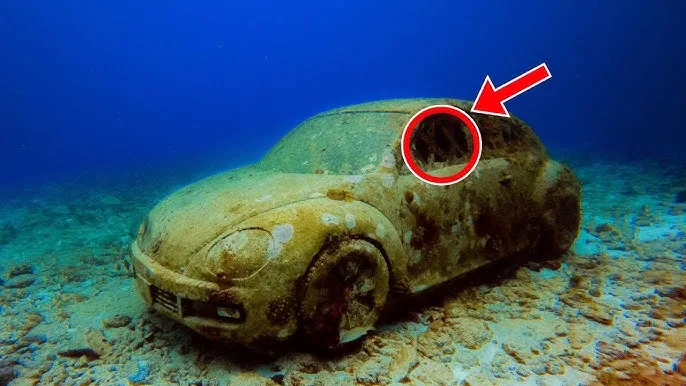
At first glance, it didn’t make sense. Not coral. Not rock. Not debris broken down by decades underwater. It was intact. Clean in its geometry. A hood. A roofline. The unmistakable curve of a fender.
A car.

It sat on the seabed as if it had been placed there deliberately, not wrecked, not torn apart by impact or decay. The team slowed without speaking, hovering closer in that unspoken way divers do when instinct says something is wrong.
Because it was wrong.
Cars don’t belong at the bottom of the ocean—at least not like this.
A Discovery That Didn’t Fit
Sunken vehicles are not unheard of in coastal waters. Storms, accidents, wartime losses—all leave traces behind. But those vehicles usually tell a violent story. They are twisted, collapsed, stripped down to frames by corrosion and currents.
This car was different.
Barnacles clung to its surface, but the lines were sharp. The panels hadn’t buckled. There were no obvious impact marks. No shattered glass clouding the sand nearby. It looked less like a wreck and more like an object that had been carefully lowered, gently set in place, and then left alone.
Jim, one of the lead divers, drifted closer and swept his light along the driver’s door.
Too clean.
That was the first detail that raised alarm. Even accounting for marine growth, the interior surfaces visible through the windows didn’t match something that had been exposed to seawater for decades. He reached out and touched the metal.
Nothing moved.
He pulled his hand back.
They circled the vehicle slowly, scanning the surrounding seabed. That’s when they noticed the second inconsistency. The sand around the car was disturbed—subtly, but unmistakably—while the area beyond remained smooth and undisturbed.
Something had been done here.
Jim signaled to attach a recovery line. The plan was straightforward. Secure the vehicle. Bring it up. Document it. Let authorities decide the next step.
But the first problem came immediately.
The car was heavier than it should have been.
Not rust-heavy. Not waterlogged. Just wrong.
The line pulled tight. The car didn’t move.
Two divers braced and lifted together. The strap creaked under tension.
Still nothing.
When the vehicle finally shifted, it moved only inches, resisting as though it were anchored to the seabed itself.
And in a way, it was.
The Cable That Changed Everything
Hovering near the front wheel well, Jim angled his light beneath the chassis.
That’s when he saw it.
A second line.
Not theirs.
A thin cable, darkened with marine growth, running from beneath the car straight into the sand. It wasn’t accidental. It wasn’t debris caught by chance.
Someone had tied this car down.

Jim stared as the cable vanished into the seabed like roots sinking into soil. He signaled immediately for everyone to back off.
The water went still.
If this was art, why anchor it?
If it was a relic, why secure it so carefully?
Cutting the cable felt wrong. Whatever this was, it had been designed to stay hidden. Destroying it without understanding felt like erasing something important.
Jim made the call to expose the cable instead.
They worked slowly, carefully pushing sand aside by hand. Inch by inch, the seabed gave way. The cable led downward to a steel ring—heavy, industrial—bolted into something beneath the sand.
Not rock.
Not coral.
Something made.
Jim’s breathing grew louder inside his regulator. Before he even signaled a question, two divers shook their heads. They felt it too. The unease. The weight of a decision that suddenly felt larger than a recovery operation.
Curiosity won.
They repositioned the straps and lifted in short, controlled pulses.
This time, the car rose—slowly, reluctantly. The steel ring held for a moment, then snapped free with a dull jolt that traveled up the line and into every diver’s chest.
As the vehicle lifted, a cloud of trapped silt spilled out. And within it, something caught the light.
A metal tag.
Tags mean ownership.
Ownership means history.
Not a Wreck, Not Art
When the car reached the surface, it drew immediate silence.
Water streamed from the doors in thin, steady lines. Barnacles crusted the panels, but the structure remained intact. There were no gaps, no collapsed sections. This was not a vehicle that had decayed naturally underwater.
Someone laughed once—short, nervous—then stopped.
Jim stepped closer and placed his hand on the driver’s door.
He tried the handle.
It shouldn’t have moved.
But it did—just a fraction.
The sound was subtle. A shift of metal. A seal loosening.
Everyone froze.
Jim pulled again, slowly.
The door opened another inch.
And something escaped that didn’t belong to the ocean.
The smell wasn’t rot. It wasn’t seawater. It was old air. Stale. Dry. Like a room that hadn’t been opened in generations.
Inside the hollowed car sat a chest, wedged where nothing should have been.
Barnacles clung to its edges, but the chest itself was dry.
Dry.
A vehicle submerged for decades should not hold dry air.
No one touched it at first.
The Chest That Waited
When Jim finally pulled the chest free, the carvings became visible.
Names.
Initials.
A date.
War era.
The lid resisted, then opened with a soft release of trapped air.
Inside were letters.
Stacks of handwritten pages, carefully wrapped and preserved. Photographs, their edges worn but faces still clear. A young man in uniform. A woman standing beside a car with the same unmistakable shape.
This wasn’t cargo.
It wasn’t art.
It was a message.

The team went through the contents slowly, aware that they were holding something never meant for them—but never meant to be lost either.
The letters spoke of waiting. Of promises. Of building something meant to last beyond the war.
One line appeared again and again:
If I don’t come back, this will.
The photographs filled in the rest.
A Soldier’s Plan
The man in the photos was a soldier stationed near the coast during wartime. Records later confirmed his assignment to salvage operations—recovering wrecks, sunken vehicles, and equipment from coastal waters.
Somewhere in that chaos, he had taken a car.
Not to drive.
To build.
He hollowed it. Reinforced it. Sealed it. Turned it into a container strong enough to survive time, pressure, and neglect. He anchored it deliberately to the seabed, choosing a location unlikely to be disturbed.
When the war pulled him away, he left behind more than letters.
He left behind proof.
The final photograph stopped everyone who saw it.
It showed the car being lowered into the water. The soldier stood knee-deep in the surf, hands resting on the roof, watching as it disappeared beneath the waves.
He looked like someone who already knew he wasn’t coming back.
When History Surfaces
Historians and archivists were contacted immediately. Records were checked.
The name was recognized.
The soldier had been declared lost at sea months after the photograph was taken. His letters were never delivered. His belongings were listed as unrecovered.
For his family, history ended with uncertainty.
Until now.
Days later, they arrived—older than the faces in the photographs, carrying the weight of decades without answers. One family member broke down before the chest was fully opened.
They recognized the handwriting instantly.
Everything they believed the ocean had taken had been waiting.
Locked inside a car at the bottom of the sea.
Why This Story Matters
This discovery wasn’t about treasure. There was no gold. No financial reward.
What surfaced instead was intention.
Someone had believed so strongly in memory, in permanence, that they engineered a solution meant to outlast war, loss, and time itself. Not for fame. Not for recognition. But so that something human—words, promises, love—would survive even if they did not.
The divers understood how close this story came to disappearing forever.
One storm.

One careless trawler.
One decision to cut the cable instead of expose it.
History doesn’t always announce itself. Sometimes it waits quietly, trusting that eventually, someone will look closely enough to notice.
The Sea as a Keeper of Stories
Oceans don’t just swallow objects. They hold onto them.
Shipwrecks become reefs. Bottles become time capsules. And sometimes, a car becomes a vault.
What makes this story remarkable isn’t just the ingenuity of the soldier who built it—it’s the reminder that even in the most chaotic moments of human history, people plan for hope.
They plan for remembrance.
They leave messages, trusting that someday, someone will care enough to listen.
This wasn’t a miracle.
It was patience.
And patience, it turns out, can last longer than war.
End Note
This article is based on a narrative reconstruction inspired by historical recovery practices and wartime archival discoveries. It is intended to highlight themes of memory, preservation, and human resilience.