
Modern society often appears driven by technology, globalization, and rapid innovation, yet many of its foundations were laid thousands of years ago by ancient civilizations. From systems of governance and law to architecture, science, art, and philosophy, early societies shaped the ways in which humans live, think, and organize communities today. Understanding the influence of ancient civilizations helps us appreciate how deeply the past continues to shape the present.
The Birth of Organized Society
Ancient civilizations such as Mesopotamia, Egypt, the Indus Valley, China, Greece, and Rome were among the first to establish organized societies. They developed structured systems of governance, trade, and social order that allowed large populations to coexist.
The concept of cities, urban planning, and centralized administration originated in these early civilizations. Modern cities—with their roads, drainage systems, zoning, and public infrastructure—owe much to ancient urban designs. The Indus Valley Civilization, for example, demonstrated advanced town planning, including grid layouts and sophisticated drainage systems, which continue to inspire modern urban development.
Foundations of Law and Governance
One of the most enduring influences of ancient civilizations is the development of legal systems. The Code of Hammurabi from ancient Mesopotamia is among the earliest known written laws. It established the idea that laws should be clearly defined, publicly known, and applicable to all members of society.
Ancient Rome further refined legal principles, including justice, equality before the law, and the presumption of innocence. Many modern legal systems worldwide are based on Roman law, which influences constitutions, civil codes, and judicial procedures.
Similarly, ancient Greece introduced the concept of democracy. Although limited in scope at the time, Athenian democracy laid the groundwork for modern democratic systems by emphasizing citizen participation, debate, and collective decision-making.
Advancements in Science and Mathematics
Ancient civilizations made remarkable contributions to science and mathematics that continue to shape modern knowledge. The Egyptians developed early medical practices, anatomy studies, and surgical techniques. Ancient Indian scholars made groundbreaking discoveries in mathematics, including the concept of zero, decimal systems, and advanced geometry.
In China, innovations such as paper, the compass, gunpowder, and printing transformed communication, navigation, and warfare. These inventions played a crucial role in the development of modern science and global exploration.
Greek philosophers and scientists, including Aristotle, Hippocrates, and Archimedes, laid the foundation for scientific inquiry and logical reasoning. Their emphasis on observation, experimentation, and rational thought remains central to modern scientific methods.
Philosophy and Ethical Thought
Modern philosophical and ethical ideas are deeply rooted in ancient civilizations. Greek philosophers such as Socrates, Plato, and Aristotle explored fundamental questions about existence, morality, knowledge, and governance. Their ideas continue to influence modern philosophy, education, and political theory.
In India, ancient texts such as the Vedas, the Upanishads, and the teachings of Buddhism and Jainism emphasized concepts such as nonviolence, compassion, mindfulness, and self-awareness. These principles have gained global relevance in modern discussions on mental health, ethics, and sustainable living.
Confucian philosophy in ancient China shaped ideas about social harmony, respect for authority, family values, and moral responsibility. These values continue to shape social structures and cultural norms in many parts of the world.
Architecture and Engineering Marvels
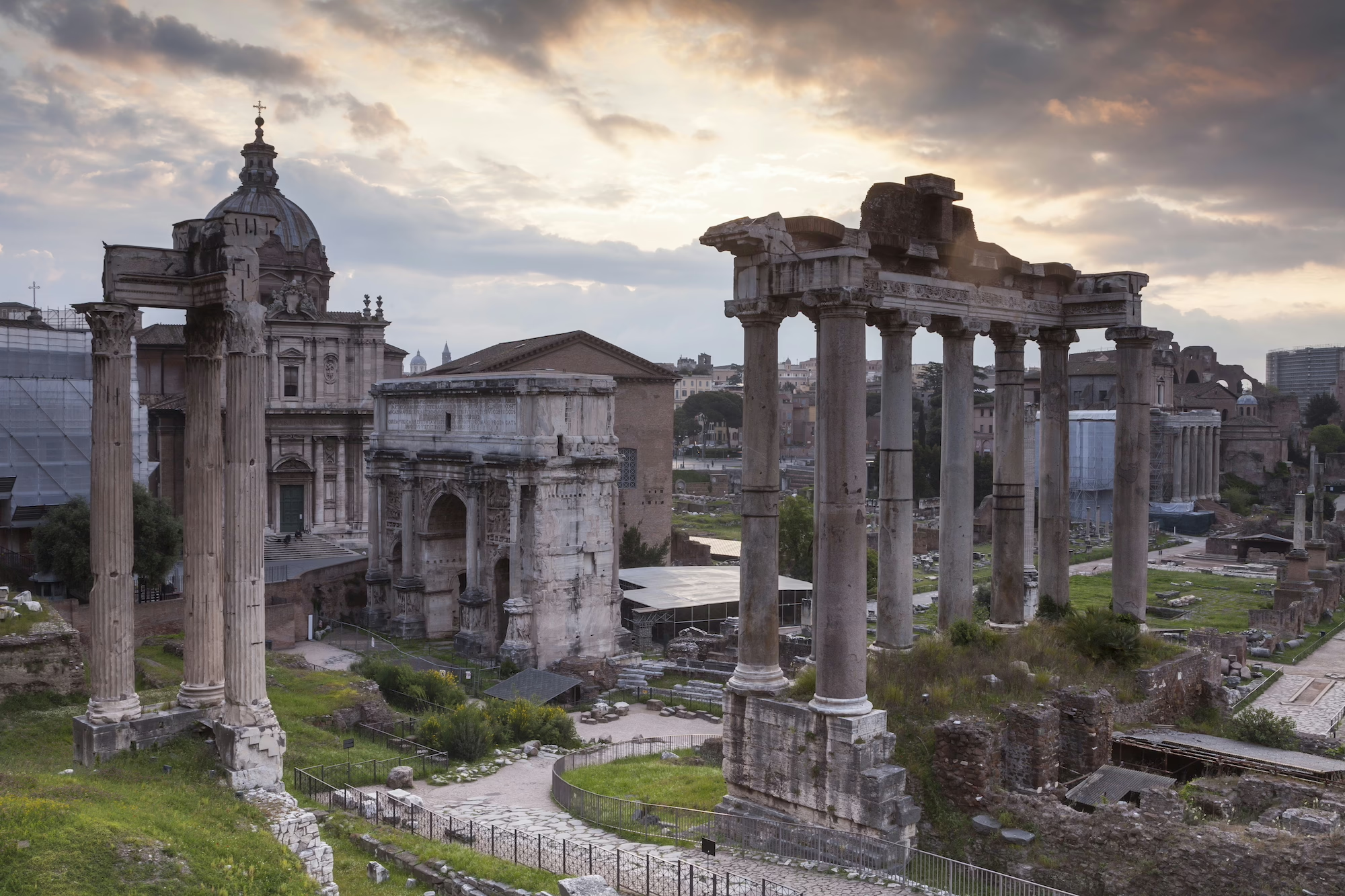
Ancient civilizations demonstrated extraordinary engineering and architectural skills that continue to inspire modern design. Structures such as the Egyptian pyramids, Roman aqueducts, Greek temples, and the Great Wall of China showcase advanced knowledge of materials, geometry, and construction techniques.
Roman innovations in concrete, arches, and road-building laid the foundation for modern infrastructure. Many roads built by the Romans remain in use today, highlighting their lasting impact on transportation and urban connectivity.
Art, Literature, and Cultural Expression
Art and literature from ancient civilizations reflect timeless human emotions and experiences. Epic works such as the Iliad, the Odyssey, the Mahabharata, and the Ramayana explore themes of heroism, duty, morality, and human struggle that remain relevant today.
Ancient art forms, sculptures, and architectural styles continue to influence modern aesthetics, fashion, and design. The use of symbolism, storytelling, and visual expression established cultural traditions that persist in contemporary art and media.
Trade, Economy, and Globalization
Ancient civilizations laid the groundwork for global trade networks. Routes such as the Silk Road connected Asia, Europe, and Africa, facilitating the exchange of goods, ideas, technologies, and cultures.
These early trade systems introduced concepts of currency, banking, and economic specialization. Modern global commerce and economic interdependence can be traced to ancient networks that facilitated cross-cultural interaction and innovation.
Conclusion
Ancient civilizations were not isolated chapters in history; they were the architects of modern society. Their contributions to governance, law, science, philosophy, architecture, and culture continue to shape how we live and think today.
By studying ancient civilizations, we gain insight into humanity’s shared heritage and recognize that progress is built upon the wisdom and achievements of the past. In many ways, modern society reflects ancient ideas—adapted, refined, and carried forward into the present.



Регулярные обновления каталога позволяют отслеживать новинки и популярные позиции.
Как правило, внешний вид и структура разделов остаются такими же, как на главном портале.