
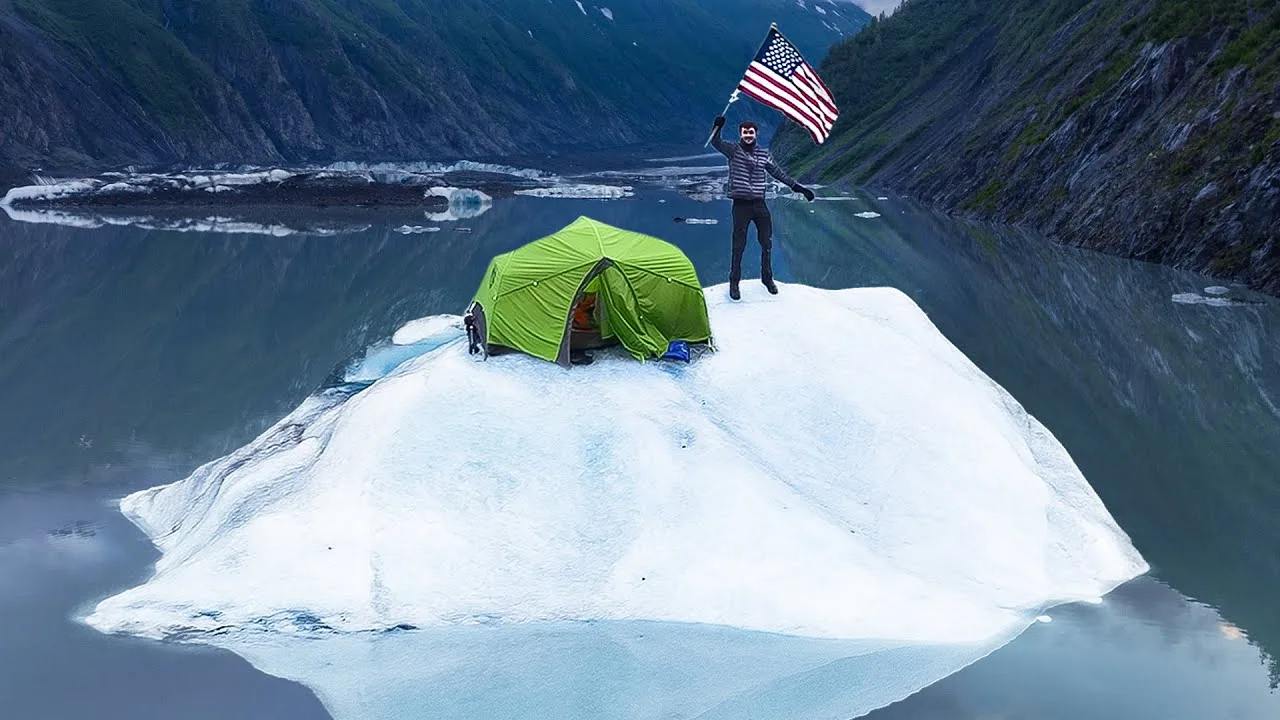
On a cold morning along Canada’s far northern coastline, something extraordinary unfolded—quietly, without warning, and entirely without explanation.
The waters off Newfoundland were calm in that peculiar way only cold seas can be. Gray and heavy, stretching endlessly beneath a sky thick with cloud cover, the ocean appeared almost motionless. Icebergs drifted as they always did this time of year—vast, sculpted forms shaped by centuries of pressure and time, their surfaces glowing faintly blue and white in the dim light.
To the people of Newfoundland, this was nothing unusual. Icebergs passed by regularly, some close enough to shore to draw curious glances, others slipping silently into the fog. They were part of the landscape, as familiar as seabirds and salt air.
But on this particular morning, one iceberg carried something that didn’t belong.
Atop its frozen crown sat a tent.
Bright orange.
Perfectly intact.
And utterly impossible.

An Anomaly on the Water
The tent stood in sharp contrast to its surroundings. Its vivid color cut through the subdued palette of gray water and ice, making it impossible to ignore. Perched near the iceberg’s center, it looked as though someone had deliberately pitched it there—zipped, secured, and waiting.
There were no visible ropes. No nearby boats. No signs of human presence.
Just an iceberg drifting slowly with the current, carrying a tent like a misplaced prop in a frozen theater.
Word traveled quickly along the coast. Fishermen paused their work. Café patrons stepped outside. Locals gathered in small clusters along the shoreline, pulling coats tighter against the biting cold as they stared across the water.
Icebergs were common.
Tents on icebergs were not.
The Gathering Crowd
As the morning progressed, more people arrived. Some brought binoculars. Others raised smartphones, zooming in on the distant shape. Conversations overlapped—questions layered atop theories.
“How did it get there?”
“Could someone be inside?”
“Is this some kind of stunt?”
Among those watching was Tom, a retired fisherman whose life had been shaped by these waters. His face bore the marks of decades at sea—creases carved by wind and salt, eyes sharpened by years of scanning horizons.
He lifted his binoculars slowly, steadying them against the cold wind.
The tent was real.

And it was definitely occupied—or so it seemed.
Tom frowned, unsettled not by fear, but by the feeling that something didn’t add up. He had seen plenty of strange things offshore over the years, but this was different. Icebergs shifted. Boats drifted. Even debris found its way into odd places.
But this?
This felt deliberate.
“What do you think, Tom?” asked Sarah, the owner of the local café, who stood beside him wrapped in a thick scarf.
He lowered the binoculars, considering his words carefully.
“Could be some thrill-seeker,” he said slowly. “Or maybe researchers studying ice movement.”
But even as he spoke, doubt lingered. The tent looked too ordinary. Too carefully placed. And the iceberg itself—though massive—was not stable enough to make such a venture sensible.
Theories spread quickly.
Some suggested it was performance art, a statement about climate change meant to provoke attention. Others speculated about extreme adventurers testing the limits of survival. A few joked nervously about publicity stunts gone wrong.
No one truly knew.
And that uncertainty only deepened the fascination.
The Moment Everything Changed
Snowflakes began to drift from the sky, light and slow, barely disturbing the surface of the water. The cold intensified, but no one left.
Then it happened.
A subtle movement.
The tent flap stirred.
At first, people thought it was the wind. Icebergs shifted constantly, and fabric could move without human—or animal—intervention. But this was different. The flap lifted, then fell back into place.
The murmuring stopped.
Every pair of eyes fixed on the tent.
The seconds stretched long and thin.
Then, with unmistakable intention, the flap opened.
What stepped out was not a person.
It was an Arctic fox.
An Unlikely Emergence
The fox’s white fur blended almost seamlessly with the ice, its form nearly disappearing against the frozen backdrop. Only its dark eyes—sharp, alert, and calm—set it apart.
For a heartbeat, the shoreline remained silent.
Then came the reaction.
Gasps gave way to laughter. Shock dissolved into delight. The absurdity of the scene—the fox, the tent, the iceberg—overwhelmed any attempt at logic.
The fox stretched leisurely, as if waking from a comfortable rest. It seemed utterly unconcerned with its audience, unconcerned even with its improbable setting. Its movements were smooth and unhurried, its posture confident.
It padded toward the edge of the iceberg, leaving faint paw prints in the snow, then paused to look out over the water.
It looked, for all the world, like a seasoned explorer surveying the horizon.
Tom let out a quiet laugh, shaking his head.
“Well,” he muttered, “I’ll be.”
A Scene That Defied Explanation
Phones came out immediately. Photos and videos were captured from every angle possible. Within minutes, images of the fox on the iceberg began spreading across social media platforms, drawing astonishment from viewers far beyond Newfoundland.
Was it real?
Had the fox somehow made the tent its shelter?
Who placed the tent there in the first place?
The fox didn’t provide answers.
It sat calmly at the iceberg’s edge, tail curled around its body, gaze fixed on the distance. There was no sign of distress. No panic. No urgency.
It looked… content.
For those watching, the moment felt surreal—like something from a storybook rather than real life.
How Could This Happen?
As the initial excitement faded, curiosity took hold.
Arctic foxes are known for their adaptability. They traverse vast distances, survive brutal conditions, and use whatever shelter they can find. It wasn’t impossible that a fox might stumble upon a tent left behind by humans.
But on an iceberg?
That raised questions.

Some locals speculated that the tent had been abandoned during an expedition and later carried away by shifting ice. Others suggested it had blown onto the iceberg during a storm. Still others wondered whether the fox had boarded the iceberg from land and claimed the tent as a temporary den.
Experts later weighed in cautiously, emphasizing that wildlife often behaves in unexpected ways, especially in regions where ice movement is common.
What mattered most, however, wasn’t the precise explanation.
It was the moment itself.
A Shared Experience
As the fox remained perched on its icy platform, the crowd gradually thinned. People returned to their routines, carrying the story with them. Conversations lingered long after the iceberg drifted farther offshore.
Tom stayed.
He watched as the fox shifted its weight, adjusting to the slow movement beneath its paws. He felt something unexpected—a sense of kinship.
The fox wasn’t performing.
It wasn’t seeking attention.
It was simply surviving, adapting, doing what life had always done in this harsh environment.
And somehow, that made the moment feel personal.
Nature’s Quiet Storytelling
In an age saturated with spectacle, this event stood out precisely because it wasn’t staged. There were no announcements, no explanations, no dramatic conclusions.
Just an animal, a tent, and an iceberg.
Nature didn’t explain itself.
It never does.
The fox eventually disappeared from view as the iceberg drifted farther out, swallowed by fog and distance. The tent remained visible for a while longer, then vanished as well.
No one saw where the fox went.
No one knew what became of the tent.
And somehow, that felt appropriate.
Why the Story Endured
In the days that followed, the images traveled far beyond Newfoundland. People across the world shared the story, drawn not by shock, but by wonder.
It became a symbol—of resilience, of curiosity, of the strange beauty that emerges when humans pause long enough to notice the world around them.
For the people who witnessed it firsthand, the memory stayed vivid.
For Tom, it became something more.
As he walked home that evening, the cold air filling his lungs, he felt a quiet gratitude. A reminder that even after decades of familiarity, the sea still held surprises. That the ordinary could, without warning, become extraordinary.
The fox had not delivered a message.
It hadn’t made a statement.
It had simply existed.
And in doing so, it had given everyone watching something rare—a moment of shared awe.
A Northern Tale That Lives On
Long after the iceberg melted and the fox vanished into the vastness of the North, the story remained.
It was told in cafés, shared with visitors, remembered on quiet mornings when the sea looked just right. It became part of the region’s living folklore—a reminder that nature doesn’t need explanation to be meaningful.
Sometimes, it just shows up.
Unexpected.
Unscripted.
Perfectly strange.
And for those lucky enough to witness it, unforgettable.
Publisher Note
This article is a narrative reconstruction inspired by eyewitness accounts and natural phenomena observed in northern coastal regions. It explores themes of wildlife adaptation, human curiosity, and the unpredictable beauty of the natural world.



shozpo
7yna06